
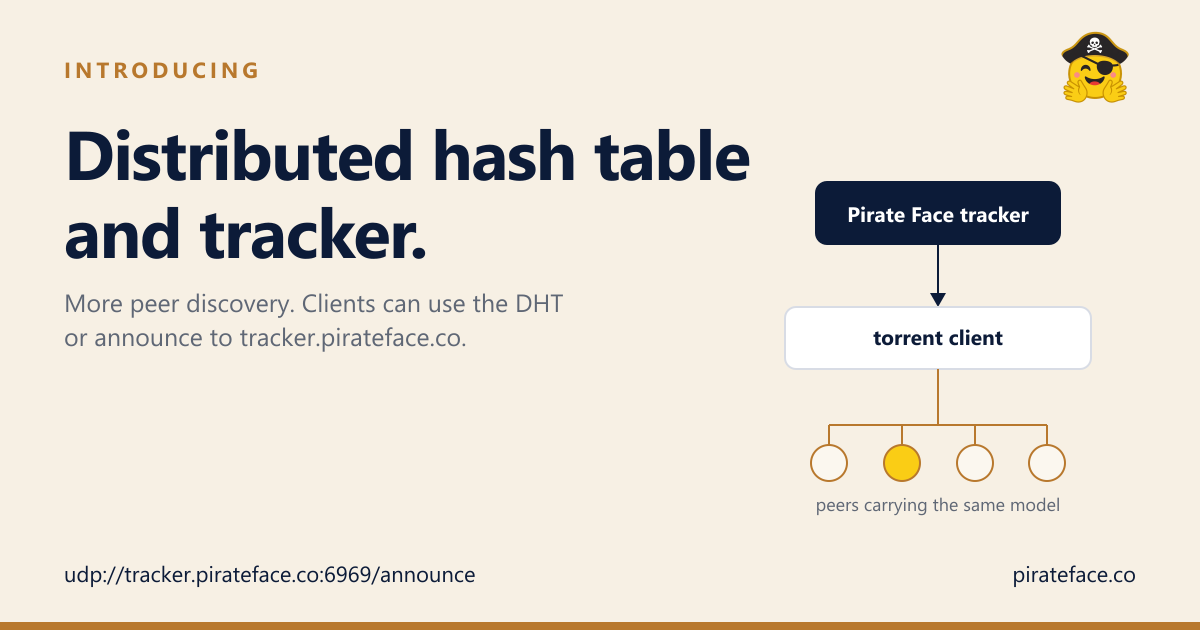
Pirate Face now operates the first-party discovery infrastructure that gives every listed model a stable path into the swarm, with distributed hash table discovery providing a second route. Torrent clients can find one another, exchange verified pieces directly, and keep models available beyond any single download source.
That infrastructure becomes stronger with every participant. Downloading a model, verifying its files, and leaving it seeding gives the next person another independent source. Submitting an eligible torrent brings another model into the network. Each contribution expands the practical resilience of sovereign AI.
This is the mission behind Making Models Permanent: preserve open model weights as verifiable public goods that can outlive a company, policy change, or outage. The tracker and distributed hash table turn that mission into a network people can join today.
Every listed magnet points clients to:
udp://tracker.pirateface.co:6969/announce
The endpoint speaks BitTorrent to torrent clients, helping peers carrying the same model find one another. Distributed hash table discovery remains enabled as another route to the swarm. This discovery layer now ships inside every magnet listed across the Pirate Face model catalog.
Two paths to the same peers
A BitTorrent download begins with an infohash, the identifier for a specific torrent. The client still needs to discover other clients that have or want its pieces.
The Pirate Face tracker provides one path. A torrent client announces the infohash to the tracker, along with the information needed to participate in the swarm. The tracker replies with peers that announced the same torrent. It coordinates discovery, but it does not host or relay the model files.
The distributed hash table, commonly shortened to DHT, provides another path. It is a distributed lookup network maintained by participating BitTorrent clients. A client can ask that network for peers associated with an infohash without depending on one tracker.
Using both gives clients more opportunities to find the swarm. The Pirate Face tracker supplies a stable first-party rendezvous point for listed models. The distributed hash table keeps peer discovery available beyond that single service.
Either discovery path can connect a client with peers carrying the same torrent.
Built into every listed magnet
People do not need to visit the tracker hostname or configure a Pirate Face account. When someone copies a magnet from a Pirate Face model page, the tracker address is already included. Compatible clients read it and announce automatically while continuing to use DHT. The live sentence-transformers/all-MiniLM-L6-v2 model page is one example.
Pirate Face rebuilds public magnets from the stored infohash and adds the first-party tracker when the magnet is served. Community submissions store the infohash without contributor-supplied trackers or web seeds, so unrelated infrastructure is not silently passed through to downloaders.
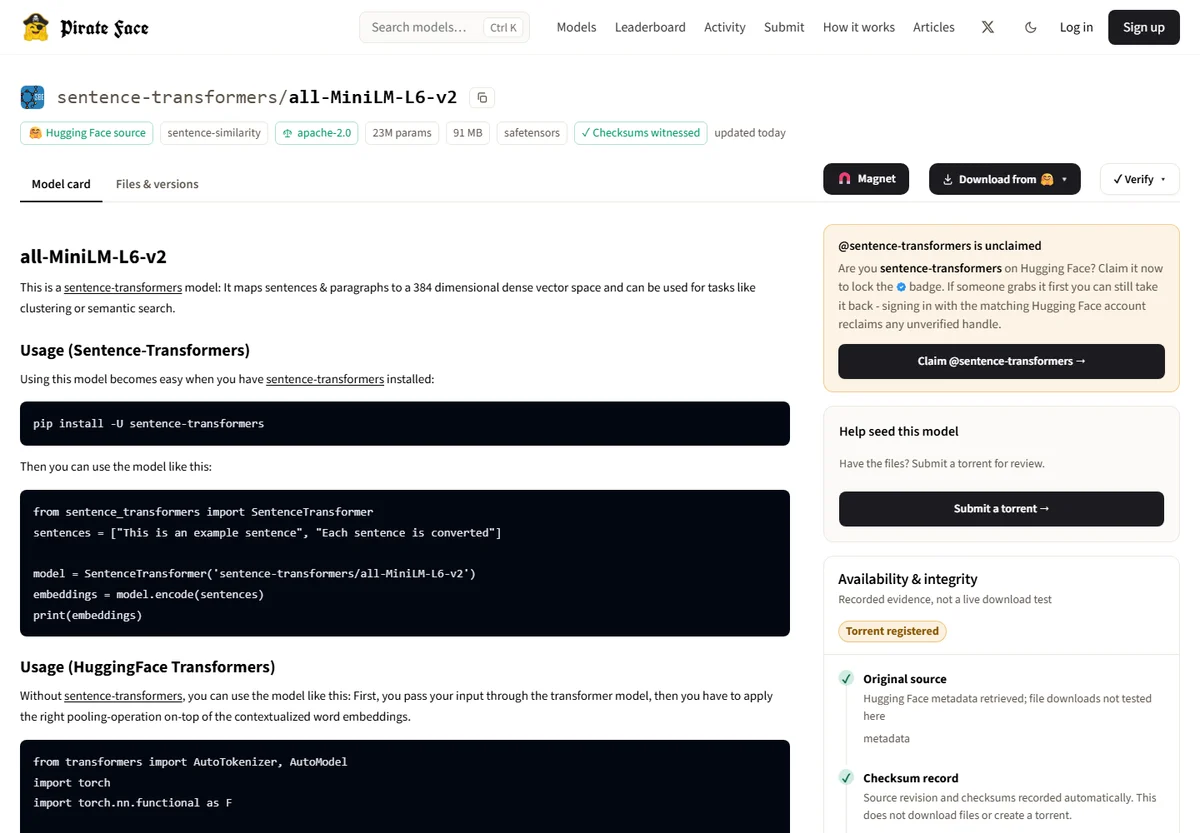
Creators and community members who already have a complete, redistributable copy can submit a torrent for review. Anyone who wants to help an existing swarm can follow the practical guide to seeding AI models.
Protocol endpoint
tracker.pirateface.co is a protocol endpoint, not a normal web page. The live tracker listens for BitTorrent traffic on port 6969. Opening the bare hostname in a browser does not test whether the tracker is working because browsers expect an HTTPS website on a different port.
Torrent clients use the complete announce address:
udp://tracker.pirateface.co:6969/announce
Measuring the swarm
Pirate Face reads seed and leech counts from its tracker and also checks DHT peer discovery for listed torrents. Tracker observations can distinguish complete peers from clients still downloading. DHT observations provide peer discovery but do not offer the same seed-and-leech split.
Public availability figures combine tracker observations with additional DHT peers while avoiding known overlap. They are observations at a point in time, not a guarantee that any particular peer will remain online.
Known overlap is removed before the combined observation is shown.
Current observations appear in Pirate Face Activity, while the provenance log records the model and checksum evidence behind the catalog.
Join the swarm
The discovery layer is live, and every new participant makes it more useful. Choose an eligible model, verify the files, and keep a complete copy available for the next peer.