Pirate Face was built because open models are too important to depend on any single platform. Its mission is to build the world’s largest peer-to-peer network for open models, helping people find, keep and share copies through open standards.
Models should never die.
Yet every week, open-weight models vanish from the internet. They get gated, relicensed, deprecated, or quietly pulled. When one disappears, everything downstream breaks: reproductions, benchmarks, fine-tunes, products, research.
It happens to the pillars, too. In July 2025, Meta sunset Papers with Code overnight - and 79,817 paper-to-code links, 9,327 leaderboards, and 5,628 datasets stopped resolving, much of it never fully recovered. ML already has a well-documented reproducibility crisis; vanishing artifacts only deepen it.
The AI commons is astonishingly valuable, yet astonishingly fragile. Hugging Face is at its heart - home to nearly 3 million open models and counting, the second million arriving in barely 11 months. But any single host, however good, is a single point of failure - for takedowns, outages, policy shifts, or simply the passage of time.
That isn't a criticism. All centralized systems carry centralized risk. And the pressure to gate or pull open-weight models on safety grounds is only growing.
A safety net.
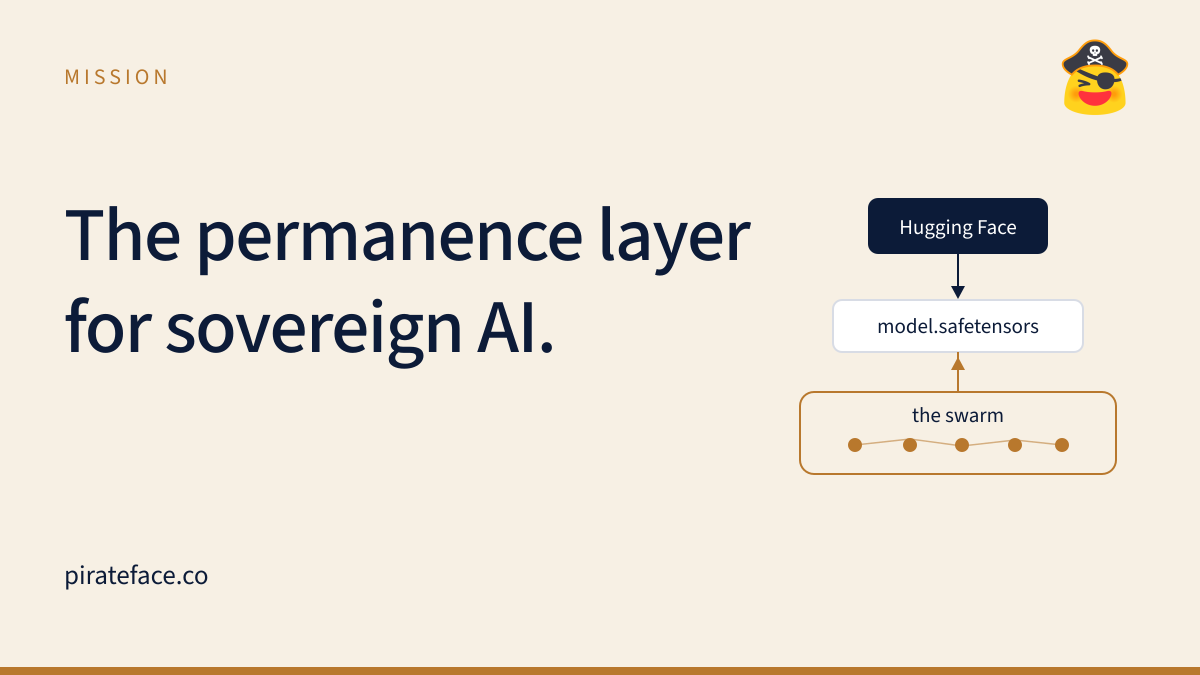
Pirate Face is the permanence layer for open models. It indexes eligible Hugging Face models, records source checksums, and lists torrents so people can keep and share model files.
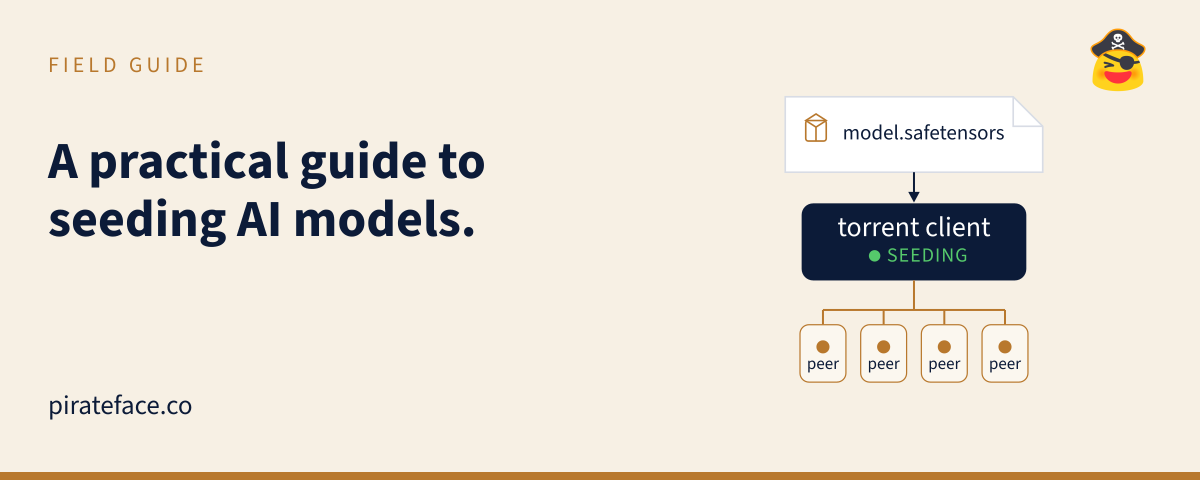
For models already on Hugging Face, webseeds help users download the files and start sharing them through torrents. Each person who keeps a copy and continues seeding helps the model become less dependent on its original host.
Publishing a magnet is the starting point. Preservation comes from independent peers keeping and sharing the files.
Building upon Hugging Face
Pirate Face builds on Hugging Face’s model ecosystem while helping people distribute copies independently. Here’s how:
Hugging Face webseeds help people obtain existing model files and start seeding. Torrent clients can download from webseeds and peers alongside each other, helping turn individual downloads into shared copies.
Pirate Face records Hugging Face’s published weight-file checksums for specific model revisions. Torrent clients verify downloaded pieces against the torrent’s hashes, while the recorded checksums provide a separate reference for checking the files against Hugging Face.
Creators can verify a Pirate Face handle through the matching Hugging Face account or organization. The badge helps people recognize verified accounts when browsing models and discussions.
For the Hugging Face ecosystem, this means more people keeping and sharing model copies beyond the original host. Those independent copies can help keep models available through source removals, outages and platform changes.
Peer-to-peer sharing adds another source of download bandwidth. When peers can supply the files, downloads can draw less data from Hugging Face.
Download models with the Pirate Face CLI, or install the pirateface package to use it in existing Python workflows without changing your code. Downloads use peers when available and fall back to Hugging Face when needed.
Permanence as a principle.
Pirate Face helps turn local model copies into a shared network, so their future depends less on any single company and more on everyone who chooses to keep them available.