
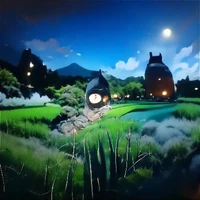
MiniMax-H3-Image pDMD 2-Step LoRA
A true 2-step mode for MiniMaxAI/MiniMax-H3-Image: the pDMD 2-NFE LoRA (arXiv 2609.35768, rank 128 over attention + FFN of all 50 blocks) merged into the official 33.1B image transformer, at the model's native 4096×4096 (16 MP) — no CFG, prompts as written. The stock checkpoint is step-distilled for its fixed 6-step PDD schedule; this LoRA lands a finished image in 2 denoising evaluations on a plain flow-matching grid.
This repo ships the LoRA in two layouts:
lora_model_0.safetensors(bf16, byte-identical to the upstream pDMD release) — diffusers-layout keys (transformer.transformer_blocks.N.attn.to_q…, split QKV). Merge this into any diffusersMiniMaxH3Transformer3DModel— P-H3-Image's, or the official checkpoint after the on-the-fly conversion inrender_grid.py.minimax_h3_pdmd_2nfe_comfyui.safetensors— the ComfyUI/native-layout conversion (fused block-diagonalqkv_proj, SwiGLU halves swapped back to[gate; value]), by Iwannapose, mirrored here for one-stop use. This is the file for ComfyUI and other native-naming stacks.minimax_h3_image_pdmd_2step_bf16.safetensors— the one-file ComfyUI checkpoint: Comfy-Org's pruned bf16 diffusion model with the pDMD LoRA pre-merged (208 deltas in fp32, base metadata preserved), verified loading and rendering in stock ComfyUI. No LoRA node needed.transformer/— the official MiniMax-H3-Image transformer pre-converted to diffusers layout (sharded bf16MiniMaxH3Transformer3DModel), so the stack below loads with a plainfrom_pretrained(..., subfolder="transformer")and no on-the-fly conversion. The official image checkpoint has no audio weights; the unused audio-branch tensors are zeros.
Try it: akhaliq/minimax-h3-image-2step — realtime ~1 MP previews as you type (a 2-step frame lands in ~1–1.5 s, with an idle detail polish when you pause), full renders and edits at 2/3/4 steps up to native 16 MP, detail pass built in (ZeroGPU). Live previews are something the stock model cannot do: its distilled schedule is fixed at 6 steps, and at 2 steps it is still mid-denoise — the LoRA is what makes 2-step framing fast enough to feel realtime.
Realtime edit mode: a Mona Lisa source, the prompt typed live, one 2-step frame per chunk (~0.9 s
per frame on the Space's FP8 build) — rendered with the Space's own realtime pipeline
(make_realtime_video.py).
Usage (ComfyUI)
Two ways in — both verified end-to-end on latest ComfyUI master (2026-11-10) with the official Comfy-Org/MiniMax-H3-Image repack: zero unmatched keys, ~20 s per 2048² image on an H200 (bf16 DiT, int8 text encoder).
The headline in ComfyUI is the same as everywhere else: 2 denoising evaluations instead of 6, so prompt and seed iteration is 2–3× faster per render — near-interactive at 2–4 MP — and the stock checkpoint cannot be driven below its fixed 6-step schedule at all.
Option A — one file (easiest). minimax_h3_image_pdmd_2step_bf16.safetensors (40 GB) is the
Comfy-Org pruned bf16 checkpoint with the pDMD LoRA pre-merged (208 deltas, fp32 math, base
metadata preserved — merge script: merge_comfy.py):
- Update ComfyUI to latest master. Download
minimax_h3_image_pdmd_2step_bf16.safetensorsintoComfyUI/models/diffusion_models/, plus a text encoder (qwen3vl_32bint8 or nvfp4) and the VAE from Comfy-Org/MiniMax-H3-Image. - Wire the graph: Load Diffusion Model → MiniMaxH3SigmaShift (shift_video 12, shift_audio 3) → Basic Guider. Text: Load CLIP (type minimax) → CLIP Text Encode (positive only; guidance-distilled). Latent: EmptyHunyuanLatentVideo at your size — the H3 image latent is a 1-frame video latent; 4096×4096 is native.
- Sample: SamplerCustomAdvanced — RandomNoise (your seed), KSamplerSelect euler, BasicScheduler scheduler simple, steps 2, denoise 1.0 → VAE Decode → Save Image.
No LoRA node, no strength to get wrong. Ready-made workflow:
workflows/minimax-h3-image-pdmd-2step-t2i.json —
drop it on the canvas after step 1; steps 2–3 are already wired in.
Option B — base + LoRA (2 GB). Already have the Comfy-Org checkpoint? Keep it and add the LoRA:
hf download akhaliq/minimax-h3-image-pdmd-2step minimax_h3_pdmd_2nfe_comfyui.safetensors --local-dir ComfyUI/models/loras
Insert LoraLoaderModelOnly (strength 1.0 — any other value scales the distillation delta)
between Load Diffusion Model and the sigma-shift node; everything else as in Option A. Ready-made
workflow: workflows/minimax-h3-image-pdmd-2step-lora-t2i.json
— the Option A graph with the LoRA node already at 1.0. The LoRA path is also the only one for the
int8_convrot/w4a8 quantized checkpoints — rotated/quantized weights cannot take a pre-merge.
Detail pass in ComfyUI (verified)
The same lightweight recipe the Space runs, in stock ComfyUI, no extra files — no refiner LoRA
needed: half-size draft at 2 steps → VAE Decode → pixel upscale (lanczos) to the final size →
VAE Encode → a second sample at 3 steps with denoise = σ₀. The start sigma is the knob, not
“low denoise”: 0.4–0.55 polishes while the draft holds; 0.7 adds more detail but can drift
or speckle on flat areas. Ready-made workflow:
workflows/minimax-h3-image-pdmd-2step-detail-t2i.json
(draft save included so you can compare stages).
The same recipe headlessly verified in stock ComfyUI: the half-size draft (left, upscaled) is as soft as a plain full-size 2-step render (right); the detail pass at denoise 0.5–0.7 (middle) is where the fur, rock and tower detail lands. Why the naive “upscale the latent + low denoise” route overcooks: a latent-space upscale without re-encoding blurs, and an arbitrary small denoise redraws texture badly on top of the blur — pixel-upscale + VAE-encode + re-noise at a controlled σ₀ is the validated fix.
Samples — 2 steps
The same twelve prompts throughout — 4096×4096, 2 denoising steps, flow shift 12, seed 3, prompts as written, ~17.7 s per image — so the grids compare tile for tile with each other and with the sister card akhaliq/p-h3-image-pdmd-2step (same prompt set, same recipe).
Why the LoRA matters: the stock transformer at 2 steps is still mid-denoise — compositions are recognizable (it is a step-distilled model, so far from noise), but soft, low-contrast and unfinished. The merged LoRA lands composition, texture and fine detail in the same two evaluations:
| Stock MiniMax-H3-Image, 2 steps | + pDMD 2-step LoRA |
|---|---|
Rendered bf16 with FlashAttention-3 (Hub kernels) on one H200 (peak 84 GB, ~17.7 s/image, all 24 images
in ~13 min) via render_grid.py.
Showcase — 2 steps, native 16 MP at every aspect ratio
Twelve new prompts, each rendered at an official ~16 MP size in the aspect ratio that fits the subject (6272×2688 21:9 down to 3072×5472 9:16), same recipe — pDMD LoRA, 2 steps, shift 12, seed 3 — at ~8 s/image:
Mosaic assembled from the full-resolution renders via render_showcase.py.
Optional detail pass — and which one to use
Lightweight (enough for most people): the same-model draft + regenerate. Render the draft at half
size with the 2-step pipeline, then regenerate at full size from (1−σ₀)·latent(upscaled draft) + σ₀·noise with 3 steps on the refiner grid (σ₀ 0.5–0.7): ~1–2 s at 4 MP, composition and style hold,
and it is what the demo Space runs by
default. For most prompts this is all the detail pass you need — what follows is the heavyweight
option for maximum micro-detail at high resolution.
For edits, lower σ₀. The same pass polishes an edit without moving it: at σ₀ 0.4–0.55 the source holds while texture sharpens; at σ₀ 0.7 it redraws more boldly — the face drifts and flat areas can speckle (a glasses edit on the Mona Lisa at three settings; the anchored draft carries the edit, the refine is text-only):
The Space skips its realtime polish for edits for exactly this reason; for a full-quality edit with the detail pass, use σ₀ ≤ 0.55.
Heavyweight: Open-H3-Regenerate-2K-IC
The 2-step drafts can be polished further with
Open-H3-Regenerate-2K-IC, the
in-context (IC) successor of the Regenerate-2K refiner: a second copy of the official transformer
carrying HyperFlow 8-step + LMS Sharp + the IC LoRA (merged in the authors' infer.py order),
regenerating each draft at its native ~16 MP size while the draft stays in the transformer's context
as reference rows (the pipeline's edit path, noised to 0.999), starting from
(1−σ₀)·latent(draft) + σ₀·noise. These are video-refinement LoRAs — the refine pass, not a straight
t2i merge, is the way to use them.
Settings, chosen by ablation (three showcase images × three variants): the authors' full recipe —
3 steps on the up3 grid, σ₀ = 0.835 — against IC-LoRA-only at σ₀ 0.7 and 0.5. Composition and
lettering held in all three; the full recipe gave the crispest micro-detail, so it is what this grid
uses (~35 s per 16 MP image, peak 95 GB on one H200, render_refine.py;
ablation sheet: rows are draft, full recipe, IC-only 0.7, IC-only 0.5).
The lower-σ₀ IC-only variants stay closer to the draft when you want less redrawing.
Zoom crops at 100% (draft | refined) — fur, dials and lettering are where the pass earns its keep:
The full refined showcase, same twelve prompts and layout as the mosaic above:
The same pass over the original 4096×4096 comparison grid (drafts → refined, composition holds tile-for-tile):
Speed (measured, bf16, FA3, one H200, 4096×4096): stock MiniMax-H3-Image on its native 6-step PDD schedule ~25.1 s/image; + pDMD 2-step ~17.4 s (1.4× faster); the IC detail pass adds ~33 s on top (~50 s total — its in-context reference rows double the transformer's tokens, and the draft is VAE-encoded at full 16 MP). The 2-step alone is the speed play; the detail pass is a quality play, and with it the pipeline is about 2× slower than the stock 6-step model.
At interactive sizes the picture flips: on the demo Space (slim FP8 + fused-Triton build, ZeroGPU RTX PRO 6000 slice), 2048×2048 renders in ~4.6 s with the detail pass on — vs ~7 s for the official 6-step Space at the same size — because the Space's built-in detail pass is the lightweight same-model regenerate (+~1–2 s at 4 MP), not the heavyweight IC refiner measured above. One caveat at σ₀ = 0.835: on flat, clean areas (studio backdrops, smooth gradients) the pass can invent speckle-like micro-texture — drop to IC-only at σ₀ 0.5–0.7, or skip the pass, for that content.
How it was run (and how to reproduce)
The official MiniMaxH3ImagePipeline class is not in a public diffusers release yet, and the official
SGLang/vLLM serving path hard-pins 6 steps. So render_grid.py takes the diffusers
route:
Update (2026-11-10): native MiniMax-H3-Image support just landed in diffusers
mainvia PR #15230 —MiniMaxH3ImageModularPipelineloads the official repo directly (full 66 GB text encoder, the official 2D image VAE, a newMiniMaxH3ImageTransformer2DModel, auto CPU offload). These grids predate the merge by hours and use the validated P-H3-stack route below; the pDMD LoRA's key fit with the new 2D transformer class is untested.
- Convert the official transformer on the fly — stream the 12 official shards and remap them into
the diffusers
MiniMaxH3Transformer3DModellayout with the key mapping vendored fromdiffusers/scripts/convert_minimax_h3_to_diffusers.py(per-head-interleaved fused QKV →to_q/to_k/to_v,[gate; value]halves ofmlp.fc1swapped for diffusers' SwiGLU). All 531 checkpoint keys map; the only uncovered model keys are the 4 unused audio-branch tensors (the image checkpoint has no audio weights). - Run it in the proven P-H3-Image stack — the converted transformer replaces the transformer inside
PrunaAI/P-H3-Image's ModularPipeline (Pruna's Qwen3-VL-4B
text encoder + text connector, video-VAE decoder,
MiniMaxH3Scheduler), the same stack as the sister card. Both grids share conditioning, VAE, seed and scheduler — the comparison is transformer ± LoRA only. - 2 steps:
scheduler.set_shift(12.0),scheduler.set_timesteps(3)(N+1 grid points for N evaluations) and passsigmas=scheduler.sigmas; no CFG, no negative prompt. The stock grid is the identical call without the merge.
Stack: torch 2.13.0, transformers 5.20.2, diffusers @ c55ec279, H200 (141 GB). Peak GPU 84 GB; the
official 66 GB text encoder is not needed in this stack (Pruna's 4B encoder + connector condition the
transformer instead), so the whole run fits comfortably on one H200.
Usage (diffusers)
lora_model_0.safetensors carries diffusers PEFT keys, so it merges straight into a diffusers
MiniMaxH3Transformer3DModel — merge_lora in render_grid.py does it in place.
Load P-H3-Image's transformer, or this repo's pre-converted official transformer/ with a plain
MiniMaxH3Transformer3DModel.from_pretrained(...) — no on-the-fly conversion needed. Then sample at
2 steps: scheduler.set_shift(12.0), scheduler.set_timesteps(3) (N+1 grid points for N evaluations),
pass sigmas=scheduler.sigmas, no CFG, no negative prompt.
pDMD's operating point is shift 12 and N+1 timesteps for N denoising evaluations; at 3–4 steps the same merge gets closer to the fully-converged look if 2 steps drifts on your prompt.
Prompting
MiniMax-H3-Image works best with long, complete visual descriptions — the kind its prompt-expansion stage produces; every grid here renders the prompt as written. MiniMax's official h3-image-prompt-writing skill documents the T2I and edit prompt shapes (T2I: a full scene description; edit: preserve → change → describe the target), and MiniMax-H3-Image-PE expands short prompts locally (also runnable as diffusers custom blocks).
License
- The pDMD 2-NFE LoRA is Apache-2.0 (© the pDMD authors; this repo redistributes it unmodified).
- Anything rendered with or derived from MiniMax-H3-Image remains governed by the MiniMax-H3-Image Community License Agreement — read it before use; it carries regional and attribution terms beyond a standard permissive license.
Citation
@misc{wang2026pdmdprojecteddistributionmatching,
      title={PDMD: Projected Distribution Matching Distillation for Video Diffusion Models},
      author={Zimo Wang and Junkun Yuan and Angtian Wang and Haotian Yang and Canyu Zhang and Siyuan Yuan and Xingchang Huang and Bo Liu and Yizhi Wang and Yiding Yang and Chongyang Ma and Gordon Guocheng Qian},
      year={2026},
      eprint={2609.35768},
      archivePrefix={arXiv},
      primaryClass={cs.CV},
      url={https://arxiv.org/abs/2609.35768},
}
Credits
- Base model: MiniMaxAI/MiniMax-H3-Image (MiniMax)
- 2-step LoRA: pdmd2026/pdmd_2NFE_lora (arXiv 2609.35768)
- Inference stack: PrunaAI/P-H3-Image ModularPipeline (Pruna AI)
- Key conversion:
diffusers/scripts/convert_minimax_h3_to_diffusers.py(Apache-2.0) - ComfyUI LoRA conversion: Iwannapose/minimax_h3_pdmd_2nfe_comfyui (Apache-2.0)
- ComfyUI repack: Comfy-Org/MiniMax-H3-Image
- Details pass: Efficient-Large-Model/Open-H3-Regenerate-2K-IC (in-context refiner)
- Demo Space: akhaliq/minimax-h3-image-2step
- Sister card (same treatment for P-H3-Image): akhaliq/p-h3-image-pdmd-2step
- Merge tooling, validation and grids: built with ML Intern, November 2026